
Vastu Directions Chart: Each Direction, Its Guardian and Use
Vastu works with eight directions, each with its guardian: Indra in the east, Agni in the south-east, Yama in the south, Nirriti in the south-west, Varuna in the west, Vayu in the north-west, Kubera in the north and Isha in the north-east, with Brahma at the centre of the house. For what goes where, the Brihat Samhita, Varahamihira's sixth-century work, names only the four corners: the shrine in the north-east, the kitchen in the south-east, household goods in the south-west, and the treasury and granary in the north-west (53.118). For the wider picture of old texts and new books, see Vastu Shastra explained.
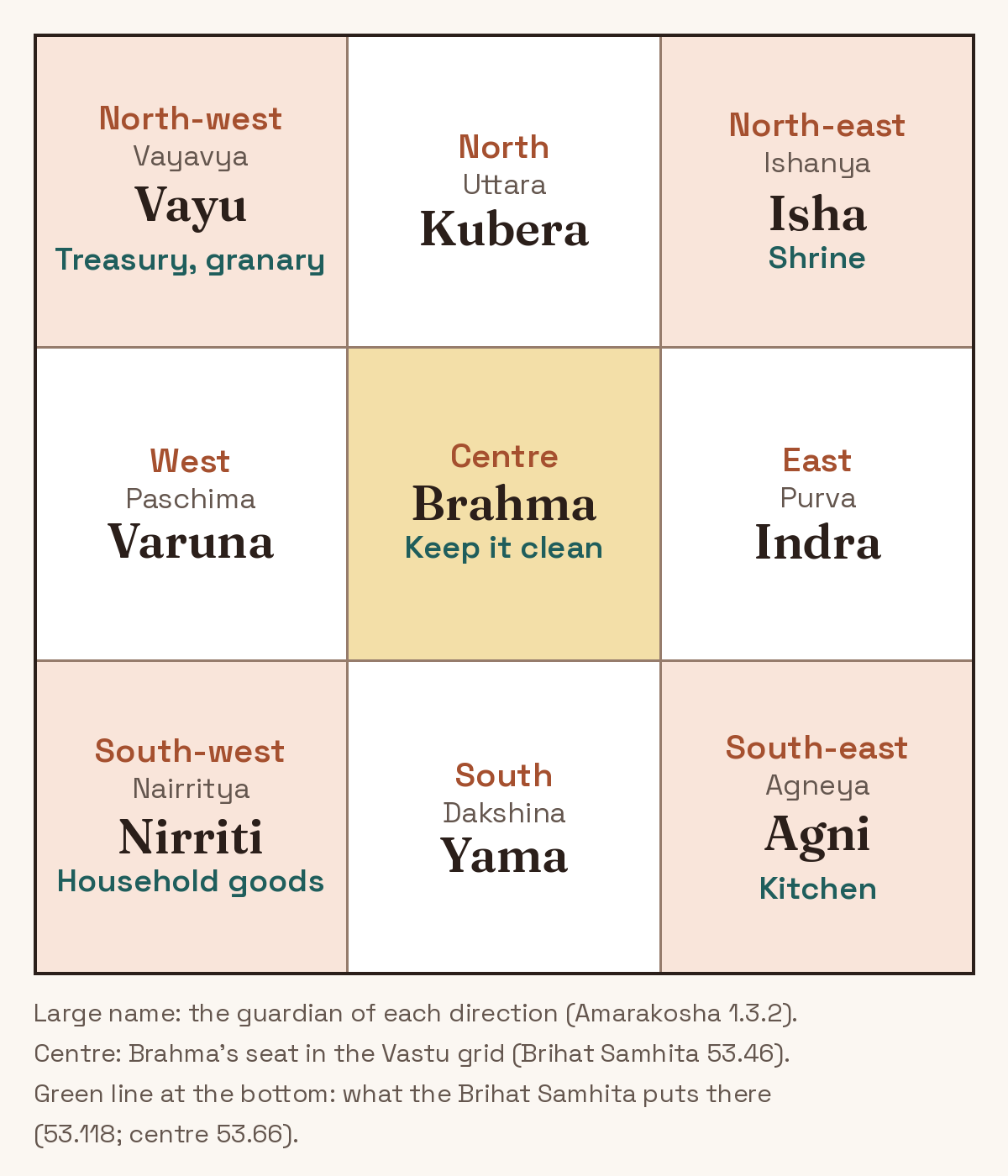
The eight guardians and the corner names
The guardians of the directions, the dikpalas, are listed in a single verse of the Amarakosha, the classical Sanskrit thesaurus (1.3.2): indro vahnih pitripatir nairrito varuno marut / kubera ishah patayah purvadinam dishan kramat. In plain words: Indra, Agni (vahni, fire), Yama (pitripati, the lord of the ancestors), Nirriti (nairrita), Varuna, Vayu (marut, the wind), Kubera and Isha are the lords of the directions, in order from the east.
The Sanskrit names of the four corners come from these guardians: Aishanya or Ishanya (north-east) from Isha, Agneya (south-east) from Agni, Nairritya (south-west) from Nirriti and Vayavya (north-west) from Vayu. The texts use them as everyday words. The Brihat Samhita's verse on rooms opens aishanyam devagriham, the house of the gods in the north-east (53.118). The four main directions are Purva (east), Dakshina (south), Paschima (west) and Uttara (north).
Keep these guardians apart from the devas of the Vastu Purusha mandala: inside that 81-square grid the Brihat Samhita seats Shikhi, a name of fire, at the north-east corner and Anila, the wind, at the south-east (53.43), and our mandala guide goes through it square by square.
What the texts put in each direction
The Brihat Samhita names the four corners only. The Matsya Purana (256.33-35), the Agni Purana (105.28-30 and 106.18-19), the Mayamata (26.216) and the Vishvakarma Prakasha, whose scheme of sixteen rooms runs round the eight directions and the points between them (2.94-98; some verses are lost, and its modern editor fills the gaps from another text), fill in more. A dash means the Brihat Samhita names nothing there.
| Direction | Brihat Samhita 53.118 | Other texts |
|---|---|---|
| North-east (Ishanya) | Shrine, "the apartment for the devas" | Shrine and a room for rites of peace (Matsya); shrine (Vishvakarma Prakasha 2.94); room for worship and the well, in the annex round the house (Mayamata 26.216); chamber for the deities (Agni 106.19) |
| East (Purva) | - | Bath (Vishvakarma Prakasha 2.94); treasure-house (Agni 106.18) |
| South-east (Agneya) | Kitchen | Kitchen, with water beside it to the north (Matsya); kitchen (Agni 106.18; Vishvakarma Prakasha 2.94) |
| South (Dakshina) | - | Bed and bedroom (Agni 105.29, 106.18) |
| South-west (Nairritya) | Household utensils and goods | All household equipment (Matsya); weapons (Agni 106.18); delivery room (Vishvakarma Prakasha 2.98) |
| West (Paschima) | - | Valuables (Agni 105.28-30); dining (Agni 106.19) |
| North-west (Vayavya) | Treasury and granary | Wealth and grain (Matsya); granary (Agni 106.19) |
| North (Uttara) | - | Storeroom (Vishvakarma Prakasha 2.94); wealth and cattle (Agni 105.28-30); store-house (Agni 106.19) |
The Vishvakarma Prakasha also names the points in between: curd-churning between the south-east and the east, a ghee store between the south-east and the south (2.95), the latrine between the south and the south-west, study between the south-west and the west (2.96), a room for weeping or anger between the west and the north-west, a couple's room between the north-west and the north, and medicines between the north and the north-east (2.96-97). The Matsya Purana keeps the bathing pavilion and the workshop outside the house altogether (256.33-35). For the kitchen in detail, see our kitchen Vastu guide.
None of these texts gives a remedy for a room that sits in a different direction (see what the texts do count as a vastu dosh). In a home that is already built, what can be done is practical: use a room differently where that is easy. The rite the tradition keeps for a house is the vastu sacrifice, which the Matsya Purana asks for on five occasions, one of them pacifying the site (256.10-11); today it is done as the Vastu Shanti, which our Vastu Shanti guide explains.
North-east Vastu and south-west Vastu
North-east (Ishanya). This is the corner of the head and of the gods. The Vastu Purusha's head lies here (Brihat Samhita 53.51), every list above puts the shrine here, and the dharma texts place some of the household's daily offerings in the north-eastern part of the house (Apastamba Dharma Sutra 2.2.3.23). Water to the north and north-east is counted good: a body of water to the north brings wealth, and to the north-east the prosperity of children (Brihat Samhita 53.119).
One popular claim runs against the texts: none of them calls it lucky to extend a house towards the north-east, and the Matsya Purana lists loss of grain as the result (256.33). For the shrine itself, see our pooja room guide.
South-west (Nairritya). This is the corner of the feet: Pitri, the ancestors, hold the Vastu Purusha's feet here (53.54). The Brihat Samhita keeps the household's utensils and goods in this corner (53.118) and the Matsya Purana all the household's equipment (256.33-35); the Mayamata puts the latrines on Nirriti's square, in an annex outside the main house (26.214). What the texts say about the ground here is that the site should rise towards the south and west (Mayamata 3.1).
Two rules you will often hear are not in the old texts: "keep heavy furniture in the south-west" and "the master bedroom belongs in the south-west". No text speaks of the weight of furniture, and the bedroom rules point elsewhere: the south in the Agni Purana (105.29, 106.18), the east side, near the south-east corner, in the Manasara (XXXVI.37). Our sleeping direction guide covers the bed and which way the head should point.
Where the texts agree and where they differ
On the slope of the land the Matsya Purana and the later treatises agree: lower to the north and east, higher to the south and west. (The Brihat Samhita's own slope verse works differently, so we leave it aside.)
The Matsya Purana asks for a site that slopes down to the east and north (256.1, 256.27). The Mayamata praises a site "rising towards the south or west, bordered by a river in the north or east" (3.20). The Samarangana Sutradhara calls good the land that slopes east and north (8.40), and the Vishvakarma Prakasha says land draining to the east brings Lakshmi, to the north the growth of one's descendants, and to the north-east a store of gems (2.15-16).
On rooms they differ. The Manasara, in P. K. Acharya's 1934 English translation, puts "the kitchens of all" in the north or north-east (XXXVI.26), far from the Brihat Samhita's south-east; that line has not been checked against the Sanskrit, so treat it as uncertain. The same text places wells around the south-east (XXXVI.27), while the Brihat Samhita says a well to the south-east of a village or town brings constant fear of fire (54.97). Even the Vastu Purusha's head moves: north-east in most texts, east in the Mayamata (7.49).
Vastu colours, elements and planets by direction: modern
Many Vastu charts online divide a house into sixteen zones and give each a planet, an element and a colour. The classical chapters these guides are based on do none of that. The Vishvakarma Prakasha does have a sixteen-room scheme, but for rooms, not for planets or colours (2.94-98); the five elements are not mapped to directions; and the only colour rule for a house site is the colour of its soil (Brihat Samhita 53.96).
The modern charts also disagree with each other: one paints the north-east yellow or cream for Jupiter, another light blue for water, and a third links it to water and the planet Mercury. Treat a direction's colour or element, and a room plan built on planets, as a modern consultant's system, not the teaching of the Vastu texts.
How to find Vastu directions in your home with a compass
The texts found east from the shadow of an upright stick, the shanku or gnomon (Mayamata chapter 6, Manasara chapter VI, Vishvakarma Prakasha 7.57-62), and the modern Hindi editor of the Vishvakarma Prakasha notes that a compass may be used instead. Today a phone compass does the job. Hold the phone flat, away from steel cupboards and appliances, which can throw the reading off, and check it in more than one spot before you decide.
How we verify: dates and muhurat timings in our guides are cross-checked against the panchang before publishing, and practical details - samagri, durations, dakshina ranges - reflect real bookings on Purohit.app. Traditions vary by community; your purohit's guidance prevails.
