
Vastu Purusha Mandala Diagram: 81 Squares and 45 Devas
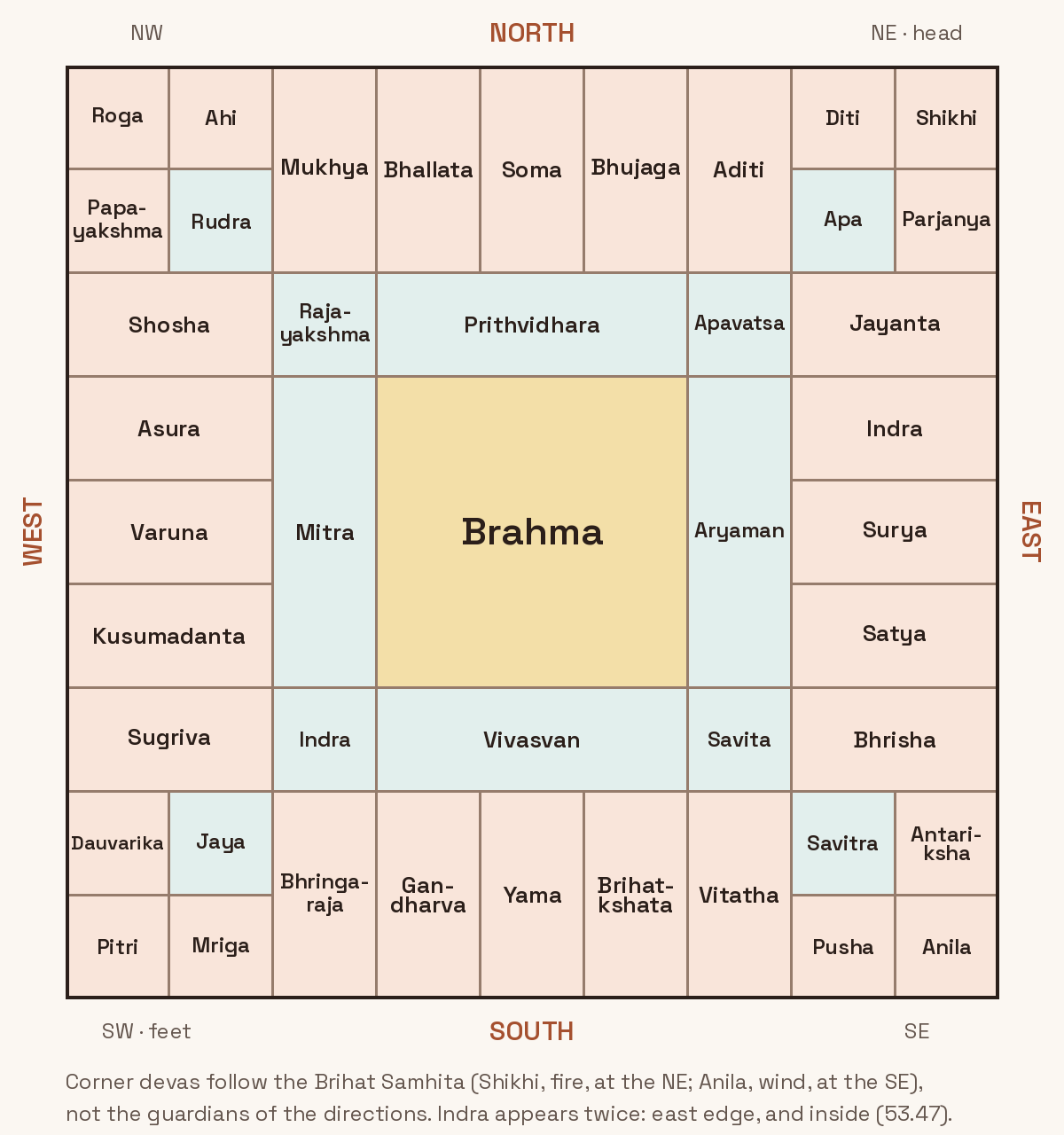
The Vastu Purusha mandala is the grid that Vastu lays over a house site: 81 squares with 45 devas seated on them, and beneath them the Vastu Purusha, lying face down with his head in the north-east and his feet in the south-west. The classic description is in the Brihat Samhita, Varahamihira's sixth-century work, chapter 53, verses 42 to 50. Below it is taken square by square, with the verse for each point and where later texts differ. For how these texts fit together, see Vastu Shastra explained.
Where the Vastu Purusha comes from
The Brihat Samhita tells the story in two verses. A being appeared whose body hid the earth and the sky. The devas seized him and laid him face down, each deva staying on the part of the body he held, and Brahma made him the Vastu Purusha, a body made of the devas themselves (53.2-3). The text does not say how he was born.
The full story is in the Matsya Purana (252.5-19). While Shiva fought the demon Andhaka, sweat fell from his forehead, and a fearsome being rose from it. It did tapas, was granted a boon, asked to devour the three worlds, and fell onto the earth, covering earth and sky. The devas, Brahma and Shiva, and even the asuras, pinned him down from every side, each staying where he pressed.
Because all the gods dwell on him, he is called Vastu (252.14). Held face down, he asked how he was to live, and the gods gave him his food, among it the bali offered in the middle of the site at the end of the daily Vaishvadeva offering, and the offerings made at the start of sacrifices and festivals (252.15-18). From then on, the text says, the vastu sacrifice has been performed for peace, shanti (252.19).
81 squares for a house, usually 64 for a temple
Ten lines drawn east to west and ten drawn north to south divide the site into 81 squares (Brihat Samhita 53.42). This is the grid for homes. The Samarangana Sutradhara, the treatise attributed to King Bhoja, gives the 81 squares to houses and royal palaces (13.3-5), and the Manasara marks them out within the length and breadth of a dwelling (XXXVI.14).
For temples most texts use 64 squares. The Brihat Samhita gives a 64-square grid as the alternative (53.55-56), and the Matsya Purana says plainly that the 64-square vastu is for the prasada, the temple (253.47). Not every text splits it this way: the Samarangana Sutradhara gives temples 100 squares, and the Mayamata, a South Indian treatise, says the 64-square grid should be used for all constructions (7.30-32), though it still places a house's doors on the 81. It lists 32 possible diagrams, from a single square up to 1,024 (7.2-21), but it and the Manasara describe only the 64 and the 81 in full.
If you read chapter 53 yourself, one caution: N. Chidambaram Iyer's 1884 English translation is wrong in more than a dozen places (in 53.43 it swaps the north-west and south-west corner squares), so where it differs from the Sanskrit we follow M. Ramakrishna Bhat's 1981 translation.
Who sits where: the 45 devas
Forty-five devas sit on the grid, 32 on the outer ring and 13 inside (53.42). Brahma takes the nine centre squares. On his four sides are Aryaman to the east, Vivasvan to the south, Mitra to the west and Prithvidhara to the north. On the diagonals around him sit Apavatsa (north-east), Savita (south-east), a second Indra whom the text calls "lord of the gods" (south-west) and Rajayakshma (north-west). In the four inner corners, in the same order, sit Apa, Savitra, Jaya and Rudra (53.46-48).
The squares are not shared equally (53.49-50). Twenty devas have one square each: the four outer corners, the eight squares beside those corners, and the eight inner devas on the diagonals and inner corners. Twenty more outer devas have two squares each, reaching one square inwards. Aryaman, Vivasvan, Mitra and Prithvidhara have three each, and Brahma nine: 20 + 40 + 12 + 9 = 81. The Mayamata shares them out differently: six squares each for the four devas round Brahma, two each for the eight devas in the inner corners, and one for every outer deva (7.58).
The text counts the outer ring wall by wall: the east wall from the north-east corner, the south wall from the south-east, the west wall from the south-west and the north wall from the north-west. Each wall's far corner belongs to the next wall (Bhat's note to 53.72-75).
| Wall | Its eight devas, in the text's order |
|---|---|
| East, from the north-east corner | Shikhi, Parjanya, Jayanta, Indra, Surya, Satya, Bhrisha, Antariksha |
| South, from the south-east corner | Anila, Pusha, Vitatha, Brihatkshata, Yama, Gandharva, Bhringaraja, Mriga |
| West, from the south-west corner | Pitri, Dauvarika, Sugriva, Kusumadanta, Varuna, Asura, Shosha, Papayakshma |
| North, from the north-west corner | Roga, Ahi, Mukhya, Bhallata, Soma, Bhujaga, Aditi, Diti |
Some names vary: Brihatkshata is also called Grihakshata, and the Mayamata calls the same square Rakshasa. The corners need one note. The Brihat Samhita seats Shikhi, the crested one, a name of fire, at the north-east and Anila, the wind, at the south-east (53.43; one manuscript reading gives Anala, fire). The Matsya Purana keeps Shikhi too, but later texts such as the Mayamata put Isha at the north-east and Agni at the south-east (7.33-38). Our drawing keeps the Brihat Samhita's names. The text also judges a main door by which of these 32 squares it sits on (53.71-75); see our main door guide.
Vastu Purusha position: how he lies on the site
He lies face down with his head in the north-east (Brihat Samhita 53.51) and his feet in the south-west, where Pitri, the ancestors, hold them (53.54). The Samarangana Sutradhara (14.2) and the Vishvakarma Prakasha (5.2-3) also lay him towards the north-east, and the Manasara puts his head on Aryaman's square but says he lies towards the north-east (VII.255). The Mayamata is the exception: it lays his head to the east (7.49), and its translator Bruno Dagens notes that other texts often place it in the north-east.
Each deva holds the part of the body he pinned down (53.51-54). The verses name the right side; the left mirrors it. A few of them:
| Part of the body | Deva who holds it | Place on the grid |
|---|---|---|
| Head | Shikhi | North-east corner |
| Breast | Aryaman | East of the centre |
| Heart | Brahma | Centre |
| Belly | Vivasvan | South of the centre |
| Right hand | Savita and Savitra | Inner south-east |
| Feet | Pitri | South-west corner |
The eight guardians of the directions (Indra in the east, Agni in the south-east and so on) are a separate list; see our Vastu directions guide.
Marmas and the brahmasthan
The points where the long lines of the grid cross, and the exact middle of every square, are marmas, the vital points of the Vastu Purusha's body (Brihat Samhita 53.57). When a house is laid out, no pillar, nail or peg should be set on them and nothing impure buried there, because harm to a marma is said to fall on the same part of the owner's body (53.58). The marmas are points on the site's grid, marked out when a house is planned on its own plot; the rule is addressed to whoever plans and builds it.
Six lines, the two diagonals and four others, cross at nine points called atimarma, the most vital of all (53.63-64). The Samarangana Sutradhara names six great marmas on the body: the mouth, heart, navel, head and both breasts (13.7). The Mayamata's version: do not torment his limbs with the "limbs" of the house (7.55-56).
The centre, the brahmasthan, belongs to Brahma. The Brihat Samhita's rule for it is cleanliness: an owner who wants prosperity should take particular care of Brahma's place and keep it from being soiled (53.66), and the verse itself names leftover food as the kind of dirt meant.
The later builders' manuals go further and keep the main building off the centre. The Mayamata places no main building on Brahma's square (26.2), leaving the middle of a four-winged house as a court, with at most a pavilion over an altar to Brahma (27.20-26), and the Manasara allows dwellings on every plot except Brahma's (XXXVI.15). The Vishvakarma Prakasha calls a pillar in the middle of the house a brahma-vedha, a piercing of Brahma, and forbids a wall there too (7.108-110).
In a flat, the builder placed the walls and pillars, and the rule against building on the centre was addressed to whoever builds. What is in your hands is the Brihat Samhita's own request: keep the middle of the home clean and uncluttered.
Why the mandala is worshipped
The mandala is drawn to be worshipped, not only to plan a house. The Matsya Purana has the 81 squares drawn and the 45 devas worshipped with havis, starting from the north-east corner (253.19-23). It names five occasions for the vastu sacrifice: laying the measuring cord, raising the pillars, raising the door frame, entering the house, and pacifying the site (256.10-11). The Brihat Samhita asks for puja to the devas before building begins (53.99; today's bhoomi puja) and again before the household enters (53.125).
Today that worship is the Vastu Shanti: the Vastu Purusha and the devas of the mandala are invoked, in fuller forms on a mandala laid out on the floor, and a havan follows. It is part of a full griha pravesh, and is also done on its own after building work or in a home you already live in. Our Vastu Shanti guide explains the havan, and the griha pravesh guide the entry ceremony around it.
How we verify: dates and muhurat timings in our guides are cross-checked against the panchang before publishing, and practical details - samagri, durations, dakshina ranges - reflect real bookings on Purohit.app. Traditions vary by community; your purohit's guidance prevails.
