
South Facing House Vastu: Good or Bad? What the Texts Say
No old Vastu text condemns a south-facing house as a whole. The texts judge something more precise: where the main door sits on the south wall. The Brihat Samhita, the Mayamata, the Manasara and the Samarangana Sutradhara all name a good door position there, the fourth of eight counted from the south-east corner, and two grihya sutras, old manuals of household rites, praise a south door outright. If you live in a flat, the short answer is that the texts say nothing about flats; the last section explains what still applies.
What the texts judge: the door's position
A "south-facing house" usually means one whose main door is on the south wall. The Vastu texts divide that wall into nine equal parts and seat a deva in each. Counting from the south-east corner, parts 1 to 8 belong to the south wall and the ninth, at the south-west corner, counts with the west (Brihat Samhita 53.72-75, as M. Ramakrishna Bhat explains it). A door takes the result of the part it opens in. Standing outside and facing the south wall, the count starts from the corner on your right. Our main door guide shows how to measure it, step by step.
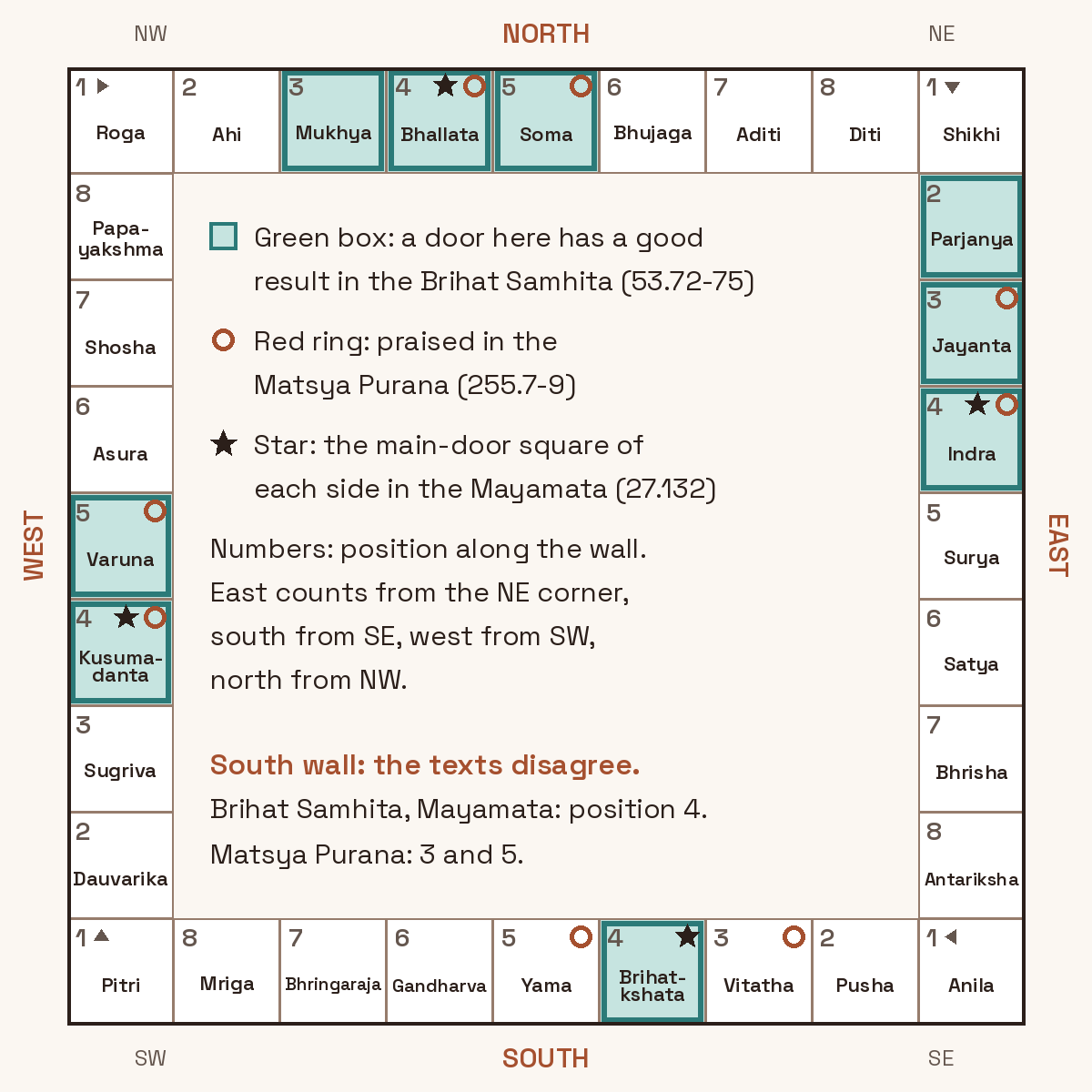
The south wall, position by position
Position 5, Yama's square, is the exact middle of the wall. South is Yama's direction in the list of guardians, and much of the worry about south doors is about him; yet the Matsya Purana praises a door in exactly this square (255.8). The building treatises prefer a house's door just off the middle of the wall (Manasara XXXVIII.50-54; Samarangana Sutradhara 39.48), and choose position 4, the square just east of it.
| Position (from the south-east corner) | Deva | Favoured for the main door by |
|---|---|---|
| 1 | Anila | None of these texts |
| 2 | Pusha | None of these texts |
| 3 | Vitatha | Matsya Purana (255.8) |
| 4 | Brihatkshata, also called Grihakshata or Rakshasa | Brihat Samhita (53.73), Mayamata (27.132), Manasara (XXXVI.66-67, XXXVIII.20-21), Samarangana Sutradhara (39.60) |
| 5 | Yama (the middle) | Matsya Purana (255.8) |
| 6 | Gandharva | Samarangana Sutradhara (39.60) |
| 7 | Bhringaraja | - |
| 8 | Mriga | - |
The Brihat Samhita, Varahamihira's sixth-century work, gives one good position on the south wall, the fourth, Brihatkshata: a door there brings "increase of food, drink and children" (53.73, Bhat's translation). It is the square just east of the middle. The same verse gives the other seven positions unfavourable results.
The building treatises name the same square. The Mayamata, a South Indian treatise, calls it Rakshasa and lists it, with one square on each other wall, as the place for an auspicious main door (27.132). The Manasara names Grihakshata among the four squares for a house's main door, with Mahendra, Pushpadanta and Mukhya (XXXVI.66-67), and its chapter on doorways puts the large south gate there too (XXXVIII.20-21).
The Samarangana Sutradhara, attributed to King Bhoja, prescribes Grihakshata for the south door as bringing good, and also allows Gandharva, the square just west of the middle (39.60). In one of its pairings of plot and house, it even praises a house facing south when the gate of its compound faces east: its owner grows in wealth and grain (39.6).
The Matsya Purana chooses differently. It praises Vitatha, the third position, and Yama's square in the very middle (255.8). So on this wall the texts disagree more than on any other: Varahamihira favours one south position, the Matsya praises two others.
The Agni Purana has its own list of eight results for the south wall (105.34-38). If it counts from the south-east corner as the Brihat Samhita does, it favours the western end - wealth, skill in a craft and children for the last three positions - the reverse of the Brihat Samhita. The text says only that its count runs round from the north-east, so where the south wall's count starts is our reading: take it as likely, not certain.
The grihya sutras, the Vedic manuals of household rites and older than all of these texts, praise a south door outright. The Gobhila Grihya Sutra says one who wants fame or strength should build with the door to the east, one who wants children or cattle with the door to the north, and one who wants all of these with the door to the south; only a west door is ruled out (4.7.15-18). The Khadira Grihya Sutra says that by a house with its door to the south "all wishes" are obtained (4.2.14-15).
The one plan where a south door is ruled out
The Brihat Samhita names five four-winged house plans (53.31-36). In one of them, the Vardhamana, a south door must not be made: dvaram tu na dakshinam karyam (53.33). The 1884 English translation found online says the opposite, that the Vardhamana has its entrance on the south; the Sanskrit and Bhat's translation do not, and the Matsya Purana agrees with them (254.3). Three of the other plans allow a south door (53.31-35). The same chapter says a three-winged house that lacks its south wing leads to loss of wealth (53.38).
Where "south facing is bad" comes from
Not from these texts. The blanket rule is not in the Brihat Samhita, the Matsya, Agni or Garuda Puranas, the grihya sutras, or the four building treatises we checked (the three above and the Vishvakarma Prakasha). We could not find where it began. What can be said is that today's consultant-led Vastu, which the scholar Vibhuti Chakrabarti (1998) describes as distinct from the old Vastu Shastra texts, grew in the late twentieth century.
The belief is strong all the same. When Telangana pulled down its old secretariat in 2020 to build a new one, ThePrint reported (31 July 2020) that Vastu experts advising the government had found faults in the old building, among them its south-facing entrance, and, citing sources, that N. T. Rama Rao, when he was chief minister of undivided Andhra Pradesh, had been asked to use another entrance for the same reason. Today some property developers write the opposite, that a south-facing home is "far from a bad omen". Neither side quotes a text.
South facing house remedies: if your door is not in a favoured position
No text we checked gives a remedy for a door in the "wrong" square, on the south wall or any other. The one rite tied to a south door is for damage: if the frame of a Grihakshata door is damaged while the house is being built, the Samarangana Sutradhara asks for worship of Yama and an expiation (42.62-65). That is about a broken frame, not about where the door stands. What the tradition does offer, you can do in any home:
- Worship the main door daily, with an offering (bali), akshata and water (Matsya Purana 255.19).
- Keep it a well-made door: one that does not swing open or shut by itself, is not cramped, and is the finest door in the house, decorated with water pots, leaves and fruit (Brihat Samhita 53.79-82).
- Keep the doorway clear. A road, tree, pillar, well or water channel straight in front of the door is a fault only within twice the height (53.76; Matsya Purana 255.14; the Vishvakarma Prakasha says twice the height of the house, 7.97-98).
- Have the vastu puja done. The Matsya Purana asks for it at the entry into a house and for pacifying the site (256.10-11); today it is done as Vastu Shanti.
The remedies sold for south doors - pyramids, copper yantras, horseshoes, convex mirrors - are not in any of these texts. The pyramid comes from the Western "pyramid power" movement, begun in the 1930s and popular in the 1970s, the horseshoe from European folk belief and the convex mirror from Chinese practice; we trace them in Vastu dosh remedies. The Brihat Samhita itself leaves room for the person: any site is auspicious for someone whose heart feels happy there (53.95).
South facing flats
In a flat, "south facing" often describes the building, not your own door, which may open onto a corridor facing anywhere. The texts were written for a house on its own plot and say nothing about flats. Modern practitioners do not agree on which counts, the building's entrance or the flat's door read with a phone compass, and there is no agreed method. The classical rule is about a door's position in an outer wall, which rarely maps onto a flat; what carries over is the door itself, kept sound, clear and honoured. See Vastu for flats and rented homes.
How we verify: dates and muhurat timings in our guides are cross-checked against the panchang before publishing, and practical details - samagri, durations, dakshina ranges - reflect real bookings on Purohit.app. Traditions vary by community; your purohit's guidance prevails.
