
Main Door Vastu for East, North, West, South Facing Houses
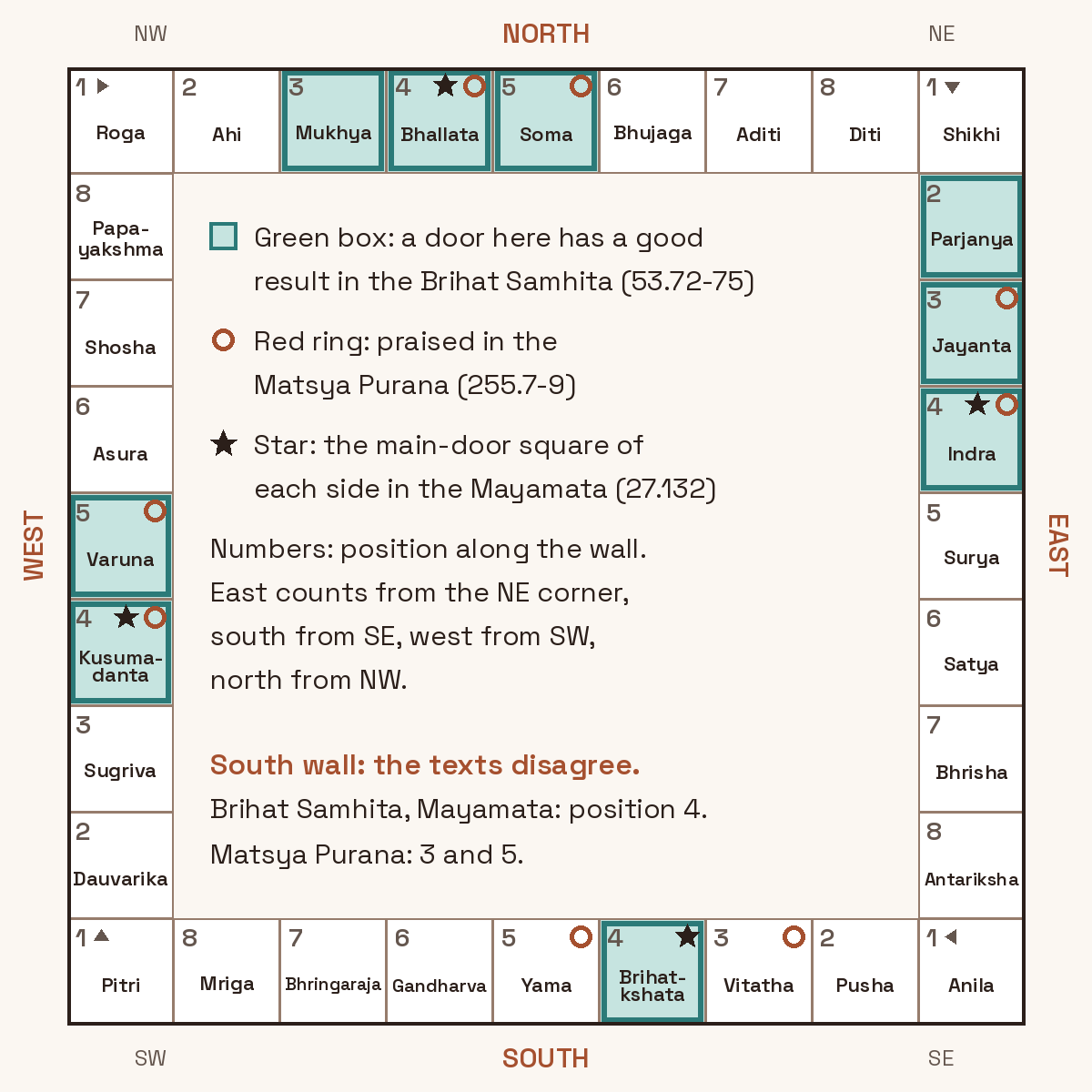
No wall is ruled out for a main door in the Vastu texts: they judge the position the door opens in on its wall, not just the direction the house faces. The Brihat Samhita, Varahamihira's sixth-century work, gives a result for each of 32 positions, eight per wall (53.71-75). Counting from the corner on your right as you face the wall from outside, it gives good results for positions 3 and 4 on an east wall (its translator also counts 2), 3 to 5 on a north wall, 4 and 5 on a west wall and 4 on a south wall. The Mayamata (27.132), the Manasara (XXXVI.66-67) and the Samarangana Sutradhara (39.59-61) name good positions too.
Why the position matters more than the facing
A house "facing east" has its main door on the east wall. The texts lay a grid of 81 squares over the house and seat 32 devas in the outer ring, eight along each wall (Brihat Samhita 53.42-45; Manasara XXXVI.14). A door takes the result of the deva whose square it opens in, so two east-facing houses can differ: a door in Indra's square is praised by the Brihat Samhita, the Matsya Purana and the Mayamata, while one in Surya's is not. For the grid itself, see the Vastu Purusha mandala.
How to find your door's position
First find which way the door's wall faces. The texts found east with a gnomon, an upright stick's shadow (Mayamata ch. 6); a compass will do, notes a modern editor of the Vishvakarma Prakasha.
- Measure the outside of the wall with the main door, corner to corner, and divide it into nine equal parts.
- Start from the north-east corner for an east wall, the south-east for a south wall, the south-west for a west wall and the north-west for a north wall. Standing outside and facing the wall, it is always the corner on your right.
- Number the parts 1 to 8 from that corner. The ninth, at the far corner, is position 1 of the next wall (Bhat's note on 53.72-75).
- See which part the door opens in. A door across two parts gives a mixed result (Vishvakarma Prakasha 7.72-73).
For example, a south wall 27 feet long has parts of 3 feet, so a door between 9 and 12 feet from the south-east corner is in position 4, the one the Brihat Samhita favours. The Vishvakarma Prakasha adds that a house with many doors and verandahs is not bound by the door rule (7.74).
If your door turns out to be in an unfavoured square, read the last section before you worry: the texts were written for choosing where to build a door, and what they give for a door already built is care of the door and the vastu puja.
The 32 positions, wall by wall
The results follow the Brihat Samhita (53.72-75) as M. Ramakrishna Bhat translates it, in our plain wording, checked against the Sanskrit. We give the good results in plain words; for the other positions we write "unfavourable" instead of repeating the old wording, and Parjanya's we mark only as counted among the good positions. Bold marks the positions Bhat counts as good; the last column shows whether the Matsya Purana or the Mayamata praises a door there.
East facing house: the east wall, from the north-east corner
| No. | Deva | Brihat Samhita | Matsya / Mayamata |
|---|---|---|---|
| 1 | Shikhi (Agni) | Unfavourable | - |
| 2 | Parjanya | Counted among the good positions (Bhat's note) | - |
| 3 | Jayanta | Great wealth | Matsya |
| 4 | Indra (Mahendra) | Royal favour | Matsya, Mayamata |
| 5 | Surya | Unfavourable | - |
| 6 | Satya | Unfavourable | - |
| 7 | Bhrisha | Unfavourable | - |
| 8 | Antariksha | Unfavourable | - |
South facing house: the south wall, from the south-east corner
| No. | Deva | Brihat Samhita | Matsya / Mayamata |
|---|---|---|---|
| 1 | Anila (Vayu) | Unfavourable | - |
| 2 | Pusha | Unfavourable | - |
| 3 | Vitatha | Unfavourable | Matsya |
| 4 | Brihatkshata (Grihakshata) | Increase of food, drink and children | Mayamata (as Rakshasa) |
| 5 | Yama | Unfavourable | Matsya |
| 6 | Gandharva | Unfavourable | - |
| 7 | Bhringaraja | Unfavourable | - |
| 8 | Mriga | Unfavourable | - |
West facing house: the west wall, from the south-west corner
| No. | Deva | Brihat Samhita | Matsya / Mayamata |
|---|---|---|---|
| 1 | Pitri | Unfavourable | - |
| 2 | Dauvarika | Unfavourable | - |
| 3 | Sugriva | Unfavourable | - |
| 4 | Kusumadanta (Pushpadanta) | Prosperity in children, wealth and fruits | Matsya, Mayamata |
| 5 | Varuna | Increase of wealth | Matsya |
| 6 | Asura | Unfavourable | - |
| 7 | Shosha | Unfavourable | - |
| 8 | Papayakshma | Unfavourable | - |
North facing house: the north wall, from the north-west corner
| No. | Deva | Brihat Samhita | Matsya / Mayamata |
|---|---|---|---|
| 1 | Roga | Unfavourable | - |
| 2 | Ahi | Unfavourable | - |
| 3 | Mukhya | Wealth and the birth of children | - |
| 4 | Bhallata | Possession of all virtues | Matsya, Mayamata |
| 5 | Soma | Children and wealth | Matsya |
| 6 | Bhujaga | Unfavourable | - |
| 7 | Aditi | Unfavourable | - |
| 8 | Diti | Unfavourable | - |
Where the texts agree, and the middle of the wall
Position 4 is the one square that both the Brihat Samhita and the Mayamata favour on every wall. Wall by wall:
- East: Jayanta and Indra (3 and 4) are favoured in both the Brihat Samhita and the Matsya. The Mayamata, the Manasara and the Samarangana Sutradhara all name Indra's square, as Mahendra.
- West: Kusumadanta and Varuna (4 and 5) are favoured in both. The other three name Kusumadanta, as Pushpadanta.
- North: Mukhya, Bhallata and Soma (3 to 5) are all good in the Brihat Samhita. All four other texts name Bhallata; the Matsya adds Soma, and the Manasara Mukhya (XXXVI.66-67).
- South: the texts part ways. Four favour position 4, and the Samarangana Sutradhara also allows 6 (39.60); the Matsya praises 3 and 5 instead (255.8). See south facing house Vastu.
The grihya sutras, older manuals of household rites, judge by direction alone: the Gobhila praises east, north and south doors and rules out the west (4.7.15-18), while the Khadira names no direction to avoid (4.2.14-15). The Vastu texts that came after them judge by position, and the five above all favour position 4 on the west wall.
Several texts keep a home's door off the exact middle. The Samarangana Sutradhara (39.48, 48.58) and the Vishvakarma Prakasha (7.85) rule out a door in the middle of the house, and the Mayamata forbids one facing Brahma's square at the centre, because through such a door "one's back is turned to Brahma upon leaving" (30.47a). The Manasara puts a home's door just left of the middle line (XXXVIII.46-54), for privacy, its translator P. K. Acharya suggests.
The Brihat Samhita and the Matsya do not follow this: Varuna and Soma, good in both, are middle squares. Varahamihira's commentator Utpala saw the clash with the chapter's own warning against a door facing Brahma (53.78) and treated the good north doors as an exception (Bhat's note).
What should not stand in front of the door
The Brihat Samhita names six things that should not stand straight in front of the main door: a road, a tree, a corner, a well, a pillar and a water channel. Farther away than twice the height, they do no harm (53.76); the Vishvakarma Prakasha says twice the height of the house (7.97-98), and the Matsya Purana has the same twice-the-height rule (255.14). The texts call this vedha, "piercing", and the Mayamata adds a boundary, a temple, an anthill and a heap of ashes (30.38b-40a).
The Vishvakarma Prakasha's marga-vedha, a road running straight at the door (7.79-80), is the classical root of today's "veedhi shoola" or T-junction rule; that modern name is not in the texts. The same work says piercing does not count when a road or a wall lies between, when the thing stands off at an angle rather than straight ahead, or when it is far away (14.49-54).
The door itself
- Sound and true. A door that swings open or shut by itself, one too big, too low, too narrow or too wide, a crooked one, and a door above another door are faults in the Brihat Samhita (53.79-81); the Matsya Purana also condemns a door above a door (255.16). Yet the Samarangana Sutradhara (39.44) and the Manasara (XXXV.382) want upper-floor doors set in line above the one below; no text explains the difference.
- Smooth to open. The Mayamata asks for a door that opens and closes smoothly and sounds like a drum beat, or a note on the veena or flute (30.33-38).
- Front and back doors not in one line. The Samarangana Sutradhara calls such a house bhinna-deha, split-bodied, one that does not grow (39.57-58).
- The finest door in the house. No other door should outdo it, and it is decorated with water pots, fruits, leaves and figures of Shiva's attendants (Brihat Samhita 53.82; Matsya Purana 255.18).
- Worshipped every day, with an offering (bali), akshata and water (Matsya Purana 255.19).
For entering a new house, see our griha pravesh guide.
When the door cannot be moved
The old Vastu texts assume a house on its own plot. A flat has one door, often onto a corridor, in a building that faces its own way. The commonest modern method is to stand at the flat's door facing out and read a phone compass; some guides weigh the building's entrance too. There is no agreed method, and no text to settle it (more in Vastu for flats and rented homes).
No text we checked gives a remedy for a door in an unfavoured position. What the tradition does give, you can do in any home: keep the door sound and its front clear, worship it daily, and have the vastu puja done, which the Matsya Purana asks for at the entry into a house and to pacify the site (256.10-11) - today's Vastu Shanti. The pyramids, horseshoes and mirrors sold for doors come from outside these texts - the Western "pyramid power" movement, European folk charms and Chinese practice; see Vastu dosh remedies.
How we verify: dates and muhurat timings in our guides are cross-checked against the panchang before publishing, and practical details - samagri, durations, dakshina ranges - reflect real bookings on Purohit.app. Traditions vary by community; your purohit's guidance prevails.
