
Invitation Card Matter: Vineet, Darshanabhilashi Meaning
A traditional Indian invitation card is built from the same parts in the same order, whatever the ceremony and the language: a line to God, the people who invite, whose ceremony it is, the request to come, the moment it has been fixed for, the place, the programme, and who is waiting to welcome you. "Card matter" is the printer's word for this text (मजकूर, majkur, in Marathi). Every ceremony's own wording guide is listed below, and the makers are all on our invitation cards page.
Card words and their meanings: vineet, darshanabhilashi, Chi., Sau. Kan., D/o
Over the names of those who invite
| On the card | What it means |
|---|---|
| विनीत (vineet) | Hindi; Bengali বিনীত: "humbly": the heading over the hosts' names |
| दर्शनाभिलाषी (darshanabhilashi) | Hindi: "eager to see you"; often over the names of younger relatives or the children |
| स्वागतोत्सुक (swagatotsuk) | Hindi: "eager to welcome you" |
| निमंत्रक (nimantrak) | Hindi: "the one who invites" |
| उत्तराकांक्षी (uttarakankshi) | Hindi; Gujarati ઉત્તરાપેક્ષી: "awaiting your reply": the RSVP, over a name and phone number |
| ~ आपले नम्र ~ | Marathi: "yours humbly" |
| ತಮ್ಮ ಆಗಮನಾಭಿಲಾಷಿಗಳು | Kannada: "those who long for your coming" |
| ఆహ్వానించువారు | Telugu: "those who invite" |
| இப்படிக்கு | Tamil: "thus, from", over the names; or இங்ஙனம் தங்கள் நல்வரவை நாடும், "thus, seeking your good arrival", or தங்கள் நல்வரவை விரும்பும், "wishing for your good arrival" |
| With best compliments from | English: the closing, over the names of relatives and friends who join in the invitation |
An Iyengar card can end with வாசிக தோஷ: க்ஷந்தவ்ய:, "please forgive any fault in the wording".
Before a name: honorifics, S/o and D/o, the late mark
| On the card | What it means |
|---|---|
| चि. / Chi. | Hindi, Marathi, English: चिरंजीव (chiranjeev), "long-lived": before the groom's name, a boy's or a young man's |
| सौ. कां. / Sau. Kan. | Hindi: सौभाग्यकांक्षिणी (saubhagyakankshini), "one who wishes for saubhagya": a bride before her wedding; some cards print सौ. का. or चि. सौ. का. |
| चि. सौ. कां. | Marathi: the bride, short for चिरंजीव सौभाग्यकांक्षिणी |
| सौ. / Sow. | Hindi, Marathi, English: सौभाग्यवती (saubhagyavati), a married woman whose husband is living; English and Kannada cards also write the bride this way, as Chi. Sow., and Telugu cards as Chi. La. Sow. |
| અ.સૌ. | Gujarati: અખંડ સૌભાગ્યવતી, before a married woman's name, usually the inviting mother's |
| ಚಿ॥ and ಚಿ॥ ಸೌ॥ | Kannada: the groom and the bride; village cards write the bride ಚಿ.ಸೌ.ಹ.ಕುಂ.ಶೋ, "long-lived, fortunate, adorned with turmeric and kumkum" |
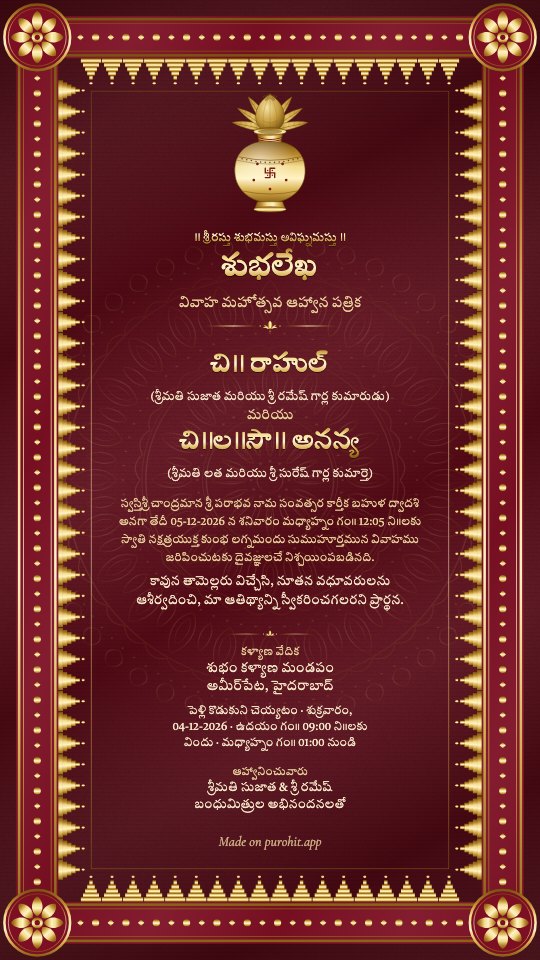
| చి॥ and చి॥ల॥సౌ॥ | Telugu: the groom, చిరంజీవి, and the bride, చిరంజీవి లక్ష్మీ సౌభాగ్యవతి |
| திருநிறைச்செல்வன் and திருநிறைச்செல்வி | Tamil: before the groom's and the bride's names |
| কল্যাণীয় and আদরণীয়া | Bengali: before the groom's and the bride's names; others print শ্রীমান for him and কল্যাণীয়া for her |
| S/o, D/o; सुपुत्र, सुपुत्री, सुपौत्र, सुपौत्री | English, Hindi: son of, daughter of; grandson, granddaughter: the line under a name |
| स्व. (swargiya), कै., ದಿ॥, కీ.శే., தெய்வத்திரு, ৺, Late | The late mark in Hindi, Marathi, Kannada, Telugu, Tamil, Bengali and English, in that order: before the name of someone who has passed away. కీ.శే. is కీర్తిశేషులు, "one of whom only the good name remains"; Bengali has a sign of its own, ৺, meaning স্বর্গীয়, "late"; ದಿ॥ is short for ದಿವಂಗತ, "departed", which some Kannada cards write in full |
| गं. भा., ગં. સ્વ. | Marathi, Gujarati: before a widow's name |
On Hindi and Marathi cards, Sau. Kan. is a bride who wishes for saubhagya and Sau. alone a married woman, so a bride is Sau. Kan. on her own wedding card and Sau. on every card after it. Use one form of the late mark across a card, स्व. or स्व०, not both, and write "grandson of" or "granddaughter of" in full: English has no settled short form for a grandchild.
Card matter in order: what goes on a card, top to bottom
- A line to God. Hindi, Marathi and Gujarati cards open with ।। श्री गणेशाय नमः ।। (Marathi ones often with ।। गजानन प्रसन्न ।।), Kannada cards with ॥ ಓಂ ಶ್ರೀ ಗಣೇಶಾಯ ನಮಃ ॥, and Telugu wedding cards with శ్రీరస్తు శుభమస్తు అవిఘ్నమస్తు, "may there be prosperity, auspiciousness and no obstacles". A Tamil card starts with உ, the pillaiyar suzhi, Ganesha's sign, then a deity's name and துணை ("with the help of"), as in கணபதி துணை. A Bengali wedding card salutes Prajapati, শ্রী শ্রী প্রজাপতয়ে নমঃ, lord of offspring and so of marriage; প্রজাপতি also means butterfly, hence the butterflies on Bengali cards.
- The family deity and a verse. The kuladevata comes in the same form (।। श्री कुलदेवी प्रसन्न ।।, ।। श्री खंडोबा प्रसन्न ।।, "|| Shree Venkateshwara Swamy Prasanna ||"), and Hindi cards often add the Vakratunda shloka, वक्रतुण्ड महाकाय सूर्यकोटि समप्रभ । निर्विघ्नं कुरु मे देव सर्वकार्येषु सर्वदा ॥. Some name the family's tradition instead: ஸ்ரீமதே ராமாநுஜாய நம: on an Iyengar card, ।। શ્રીનાથજી પ્રસન્ન ।। on a Pushtimarg Gujarati one, a vachana of Basavanna on a Lingayat one.
- A greeting: मान्यवर, ("respected one") in Hindi; स. न. वि. वि. in Marathi, short for सप्रेम नमस्कार, विनंती विशेष ("loving greetings, and a special request"), usually followed by आमचे येथे श्री कृपेकरून, "at our home, by God's grace"; அன்புடையீர், in Tamil.
- Who invites: the senior-most of the house; elders who have passed away can still head the card, with the late mark before the name. Hindi and Gujarati cards usually name the mother first (श्रीमती सुनीता एवं श्री राजेश जी), a Gujarati one with અ.સૌ. before her name.
- Whose ceremony it is, in the largest letters, with an honorific before the name and a line saying whose child or grandchild it is: (सुपुत्र - ...), (सुपुत्री - ...) or (सुपौत्र - ...) in Hindi, S/o or D/o in English.
- The request to come and bless: सपरिवार पधारकर वर-वधू को शुभाशीर्वाद प्रदान कर हमें अनुगृहीत करें on a Hindi wedding card, आपण सहकुटुंब उपस्थित राहून बटूस शुभाशीर्वाद द्यावेत ही विनंती on a Marathi munj card, ಸಹಪರಿವಾರ ಸಮೇತರಾಗಿ ಆಗಮಿಸಿ ಆಶೀರ್ವದಿಸಬೇಕಾಗಿ ವಿನಂತಿ on a Kannada one, சுற்றமும் நட்பும் சூழ வருகை தந்து ("come surrounded by your relatives and friends") on a Tamil one.
- The moment and the place: the date and the muhurat time, and on most cards the tithi, the month and the year, with the lagna on Kannada, Telugu and Tamil cards and the nakshatra on Telugu and Tamil ones. Then the place: विवाह स्थल, or निवास स्थान for a ceremony at home.
- The programme and the meal. Hindi cards head the list मांगलिक कार्यक्रम and give the meal its own row, प्रीतिभोज (pritibhoj) सायं 8 बजे से आपके आगमन तक: "from 8 pm until you arrive", the food waits for the guest. Telugu cards ask you to accept భోజన తాంబూలాదులు, the meal and the tambulam after it.
- The closing: one of the words above over the names of those who invite, then the rest of the family and, on many cards, a line from the children.
Child request lines
Many wedding cards end with a small line from the children of the inviting side, pressing you to come, with their names: the child request line, headed मीठी मनुहार (meethi manuhar, "sweet insistence") on Rajasthani and Marwari cards and called ટહુકો (tahuko, a bird's call) on Gujarati ones.
- मीठी मनुहार : हमारे चाचू की शादी में ज़रूर-ज़रूर आना - आरव, पीहू
- Do come to our chachu's wedding! - Aarav and Pihu
Our English wedding card matter and Hindi wedding card matter guides have the full wording for each host and a full set of these lines to copy, and our Hindi and Marathi wedding card makers have a box for one.
Wedding card: shadi card, lagna patrika, subhalekha, kankotri
The card has a name in every region: shadi card or nimantran patra in Hindi, where a card calls itself a कुमकुम पत्रिका; lagna patrika in Marathi; lagna patrike or maduve kareyole ("the wedding's calling letter") in Kannada; subhalekha or pelli patrika in Telugu; thirumana azhaippithazh in Tamil, which people search as kalyana pathirikai; kankotri in Gujarat; the biyer card in Bengal; and ക്ഷണപത്രം (kshanapathram) on Kerala cards.
- The date line differs by region. Hindi cards print शुभ मिती with the North Indian month, which turns at Purnima, and the Vikram Samvat, with no nakshatra or lagna. Marathi cards use the amanta month, which ends at Amavasya, and the Shaka year. Bengali cards put the Bengali date in brackets after the English one and name the lagna, often গোধূলি লগ্ন (the twilight lagna), without a clock time; Kerala cards give the Kollavarsham date in brackets.
- The lagna patrika can also be a separate paper. In Telugu homes the purohit has the muhurat written down as a lagna patrika at the engagement, and the two families exchange it with tambulam; the guests' card is the subhalekha. In the Hindi belt the lagan patrika or पीली चिट्ठी (pili chitthi, on yellow or turmeric-touched paper) is written by the pandit and sent between the two families. In Marathi and Kannada the word is the guests' card itself.
The wedding card maker fills in the date line for your date, muhurat and city.
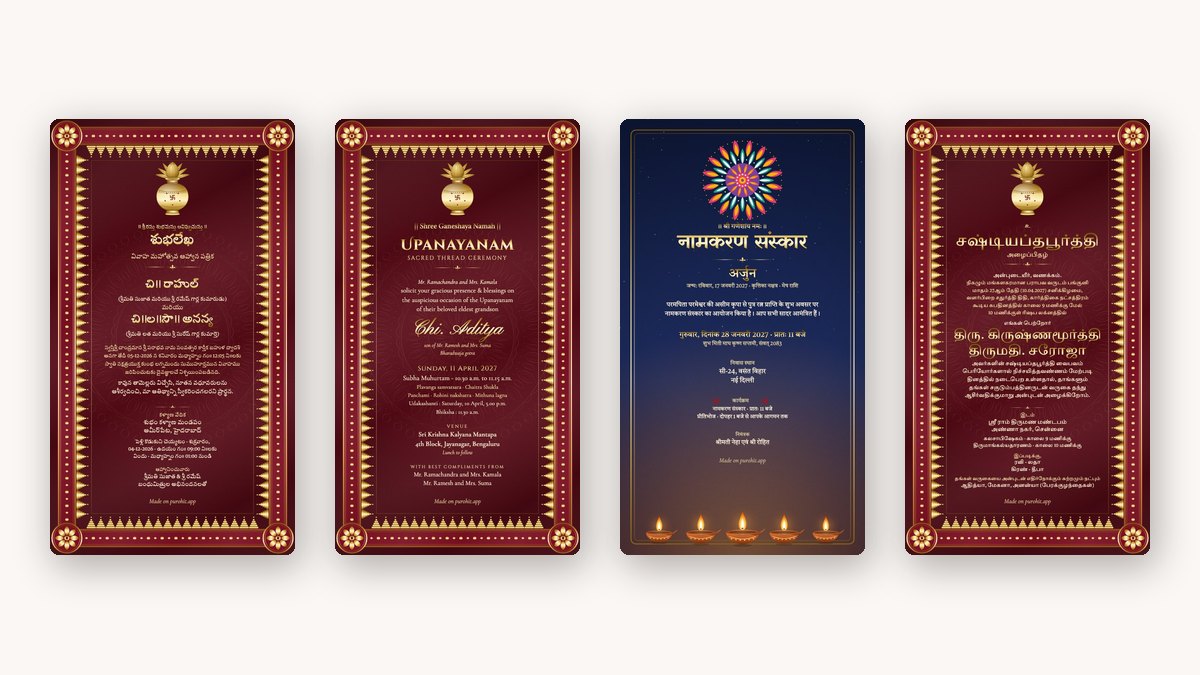
Every other ceremony's card, and its wording guide
Each has a guide with complete wording, and a maker that writes the card for your date.
- Engagement: sagai, roka, tilak, sakharpuda, nischitartham. A short wedding card with the ceremony's own name as the title; in Maharashtra, wedding invitations traditionally go out only after the sakharpuda. Wording: sagai card matter. Card: engagement card maker.
- Griha pravesh (housewarming): gruhapravesam, vastu shanti, puthumanai puguvizha, palukachal (പാലുകാച്ചൽ, the boiling of milk) in Kerala. The address matters most, and a muhurat before sunrise is printed as the calendar morning guests come. Wording: griha pravesh invitation message. Card: griha pravesh invitation maker, with a map code.
- Naming ceremony: namakaran, barasala, barsa, peyar soottu vizha. Usually the 11th or 12th day; the name is printed or kept for the day, and printed cards seldom carry the birth star. Wording: naming ceremony and barasala invitation. Card: naming ceremony maker.
- Annaprashan: mukhe bhaat, choroonu, pasni. The first rice, most often in the 6th month for a boy and the 5th or 7th for a girl; in Bengal the maternal uncle feeds the first spoon. Wording: annaprashan invitation. Card: annaprashan maker.
- Mundan: chudakarana, jawal, babri, mottai, kadhani vizha. Usually in the 1st or 3rd year; a Tamil card is usually for the ear piercing, often with the tonsure the same day and often at a temple. Wording: mundan invitation. Card: mundan maker.
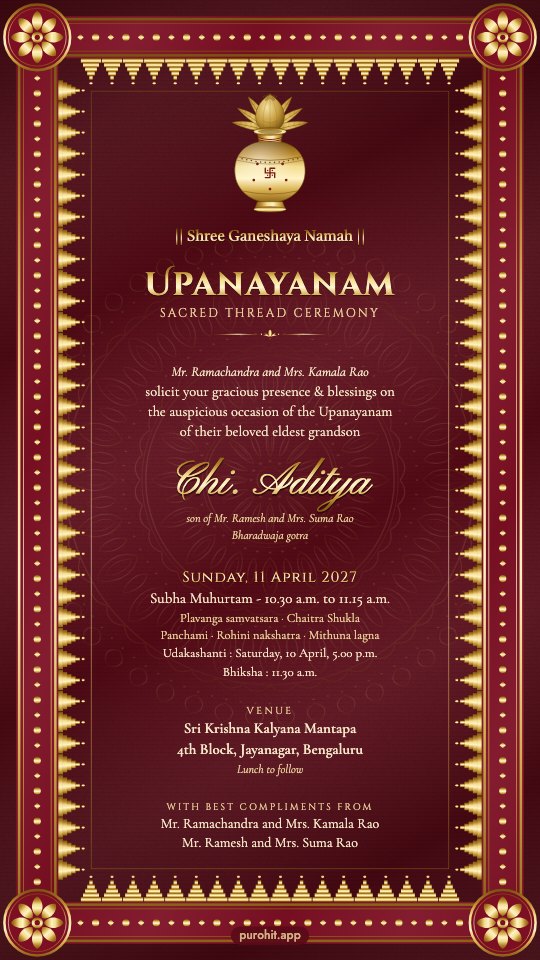
- Upanayanam (thread ceremony): janeu, munj, poonal, odugu. The grandparents or the parents invite, the boy is the vatu, and the programme carries the udakashanti and the bhiksha. Wording: upanayanam invitation, and munj patrika majkur for Marathi. Card: upanayanam invitation maker.
- Baby shower: seemantham, valaikappu, godh bharai, dohale jevan, sadh. The card names her through her husband or her in-laws, and never says whether the baby is a boy or a girl. Wording: seemantham and baby shower invitation. Card: baby shower invitation maker.
- Half saree: langa voni, pavadai dhavani, manjal neerattu vizha. The traditional Telugu card states the day she came of age; a Tamil card lets the ceremony's name say it. Wording: half saree function invitation. Card: the Telugu and Tamil makers.
- Shashtipoorthi (60th birthday): manivizha, arubathaam kalyanam; and the sathabhishekam around 80. The children invite, both parents are named together, and the mangalsutra is tied again. Wording: shashtipoorthi invitation. Card: shashtipoorthi invitation maker.
- Satyanarayan puja: katha, mahapuja, vratam. A katha held in the evening after Purnima has ended is no longer on Purnima. Wording: Satyanarayan puja invitation message. Card: Satyanarayan puja invitation maker, which lists your city's coming Purnima days.
Shradhanjali and death cards: prayer meeting, besnu, terahvi, punyatithi
A Hindi or English card informs and requests (सूचित किया जाता है, आपसे विनम्र प्रार्थना है), never "cordially invite" or "celebrate". Telugu cards for the later rites do call themselves an invitation (ఆహ్వాన పత్రిక), as does a Tamil card template (நினைவஞ்சலி அழைப்பிதழ்), because guests come to a meal; none of them celebrates.
- The kinds: the notice of the death, the shok sandesh or shradhanjali, often with भावपूर्ण श्रद्धांजलि ("heartfelt tribute"); the prayer meeting, the उठावना (uthavna) of Rajasthan and Madhya Pradesh, the चौथा (chautha) on the 4th day in Punjabi and Delhi homes, or the besnu and the uthamnu of Gujarati homes; the 10th to 13th day rites, the तेरहवीं (terahvi), the ब्रह्मभोज (brahmbhoj) and the रस्म पगड़ी (rasam pagdi, the turban tied on the eldest son as the new head of the family) in Hindi, the dashkriya (दशक्रिया) in Marathi, the ವೈಕುಂಠ ಸಮಾರಾಧನೆ in Kannada, the pedda karma (పెద్ద కర్మ) in Telugu; and the punyatithi, the death anniversary (ప్రథమ వర్ధంతి for the first in Telugu), the first of which Hindi homes also call the barsi.
- At the top, ॥ ॐ शांति ॐ ॥ (Om Shanti) takes Ganesha's place, or the Gita verse नैनं छिन्दन्ति शस्त्राणि नैनं दहति पावकः (2.23).
- The name of the one who has passed leads, with the late mark, a photo and often the years, and the family signs as mourners: शोकाकुल in Hindi, ಇಂತಿ ದುಃಖತಪ್ತರು in Kannada, దుఃఖిత కుటుంబ సభ్యులు in Telugu.
- What it never carries: a swastika, a kalash, the words शुभ or मांगलिक, an RSVP or a children's line. A white or cream card suits it.
Our shradhanjali message guide has twenty-seven wordings, most in Hindi and Gujarati, and the shradhanjali card maker makes the notice, the rites card or the punyatithi card, working out the coming year's punyatithi from the tithi of the death.
The first invitation card to God, and handing cards over
- The first card goes to God. Hindi cards print the Ganesh nimantran doha for it: विघ्न हरन मंगल करन, श्री गणपति महाराज । प्रथम निमंत्रण आपको, पूरण करियो सब काज ॥ ("remover of obstacles, bringer of good, Shri Ganapati Maharaj: the first invitation is yours; complete every task"). Many homes give the first card to Ganesha or the family deity, and at Trinetra Ganesh in Ranthambore fort thousands of wedding cards arrive by post every year to be set before the deity.
- It comes with something in the hand: sweets or dry fruit in much of the North; betel leaves, areca nut, flowers and kumkum in some Tamil homes. Telugu cards get turmeric on all four edges, as new account books do, to welcome Lakshmi.
- On WhatsApp, send the card as an image, then the venue's map link as its own message so it can be tapped, and still call the elders yourself.
Before you print or send it
- Check the date line against a calendar. The weekday is often left over from a copied sample. A Hindi card's संवत् is the Vikram Samvat, 57 years ahead of the calendar year from Chaitra Shukla Pratipada and 56 ahead before it (2084 from 7 April 2027), not the Shaka year; a Gujarati kankotri's samvat turns instead at the Gujarati New Year, just after Diwali. A tithi can end during the day or the night, so the tithi at sunrise and the one at the muhurat can differ; our panchang shows when each ends, and your purohit decides which goes on the card.
- A muhurat after midnight is written differently in different regions: Hindi cards keep the evening's date and weekday, Telugu cards keep the evening's date and weekday and add (తెల్లవారితే ...) with the next day's name ("dawning Friday"), and Tamil cards print the morning's date.
- Spell every name the same way wherever it appears, in every script on the card.
- Test the map code on a printed copy and on one forwarded over WhatsApp (dark on light, about 2 cm wide), and make two files: a tall image for the phone and a print file with a margin for the cutter.
- Ask the printer for a proof, read every name and the date line on it, and show the date line to your purohit before anything is printed.
Each of our makers starts from wording like this in the card's own language and works out the date line for your date, muhurat and city. If you also need a purohit, you can request one.
How we verify: dates and muhurat timings in our guides are cross-checked against the panchang before publishing, and practical details - samagri, durations, dakshina ranges - reflect real bookings on Purohit.app. Traditions vary by community; your purohit's guidance prevails.